
Gemstone Cutting (Faceting): Meaning, Methods, and Types Explained
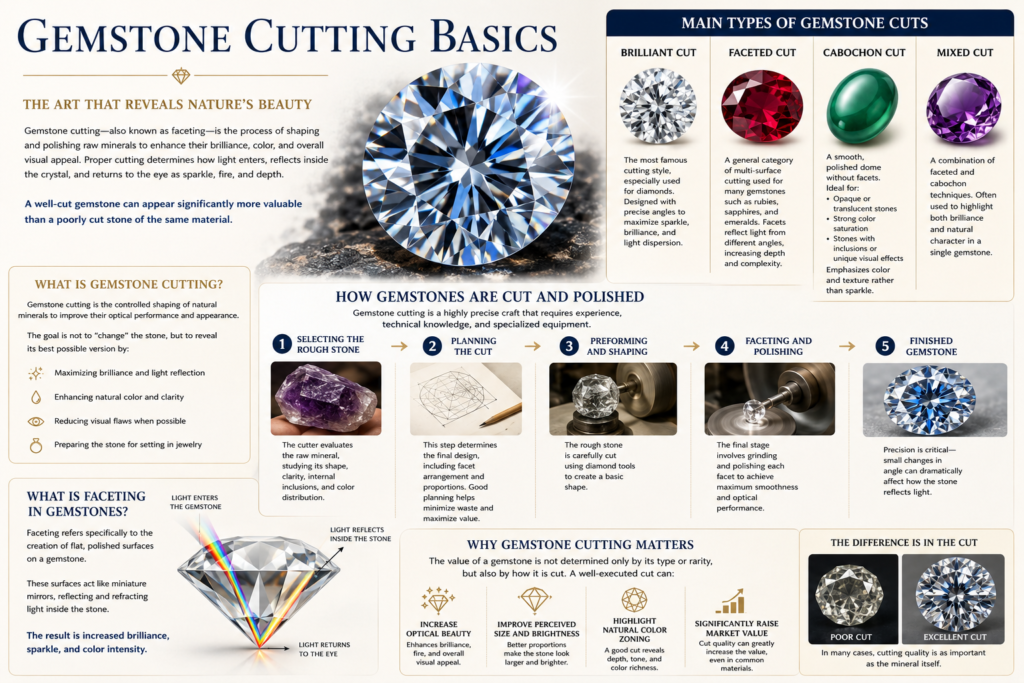
Gemstone cutting, also known as faceting, is the process of shaping and polishing raw minerals to enhance their brilliance, color, and overall visual appeal. Beyond aesthetics, proper cutting also increases a gemstone’s market value and determines how effectively it interacts with light. When a stone is cut correctly, light enters, reflects inside the crystal structure, and returns to the eye as sparkle, fire, and depth. This is what transforms a rough mineral into a gemstone suitable for fine jewelry.
What Is Gemstone Cutting?
Gemstone cutting is the controlled shaping of natural minerals to improve their optical performance and appearance.
The goal is not to “change” the stone, but to reveal its best possible version by:
- Maximizing brilliance and light reflection
- Enhancing natural color and clarity
- Reducing visual flaws when possible
- Preparing the stone for setting in jewelry
A well-cut gemstone can appear significantly more valuable than a poorly cut stone of the same material.
Main Types of Gemstone Cuts
Different cutting styles are used depending on the mineral type, structure, and desired visual effect.
Brilliant Cut
The most famous cutting style, especially used for diamonds.
It is designed with precise angles to maximize sparkle, brilliance, and light dispersion.
Faceted Cut
A general category of multi-surface cutting used for many gemstones such as rubies, sapphires, and emeralds.
It creates multiple flat surfaces (facets) that reflect light from different angles, increasing depth and visual complexity.
Cabochon Cut
A smooth, polished dome without facets.
This style is ideal for:
- Opaque or translucent stones
- Gems with strong color saturation
- Stones with internal inclusions that create unique visual effects
Cabochons emphasize color and texture rather than sparkle.
Mixed Cut
A combination of faceted and cabochon techniques.
It is often used to highlight both brilliance and natural character in a single gemstone.
How Gemstones Are Cut and Polished
Gemstone cutting is a highly precise craft that requires experience, technical knowledge, and specialized equipment. The process usually includes several key stages:
- Selecting the Rough Stone: The cutter evaluates the raw mineral, studying its shape, clarity, internal inclusions, and color distribution.
- Planning the Cut: This step determines the final design, including facet arrangement and proportions. Good planning helps minimize waste and maximize value.
- Preforming and Shaping: The rough stone is carefully cut using diamond tools to create a basic shape.
- Faceting and Polishing: The final stage involves grinding and polishing each facet to achieve maximum smoothness and optical performance.
Precision is critical—small changes in angle can dramatically affect how the stone reflects light.
What Is Faceting in Gemstones?
Faceting refers specifically to the creation of flat, polished surfaces on a gemstone.
These surfaces act like miniature mirrors, reflecting and refracting light inside the stone. The result is increased brilliance, sparkle, and color intensity.
Faceting is one of the most important techniques in modern gem cutting and is widely used in both jewelry production and gemstone collecting.
Why Gemstone Cutting Matters
The value of a gemstone is not determined only by its type or rarity, but also by how it is cut. A well-executed cut can:
- Increase optical beauty
- Improve perceived size and brightness
- Highlight natural color zoning
- Significantly raise market value
In many cases, cutting quality is as important as the mineral itself.